
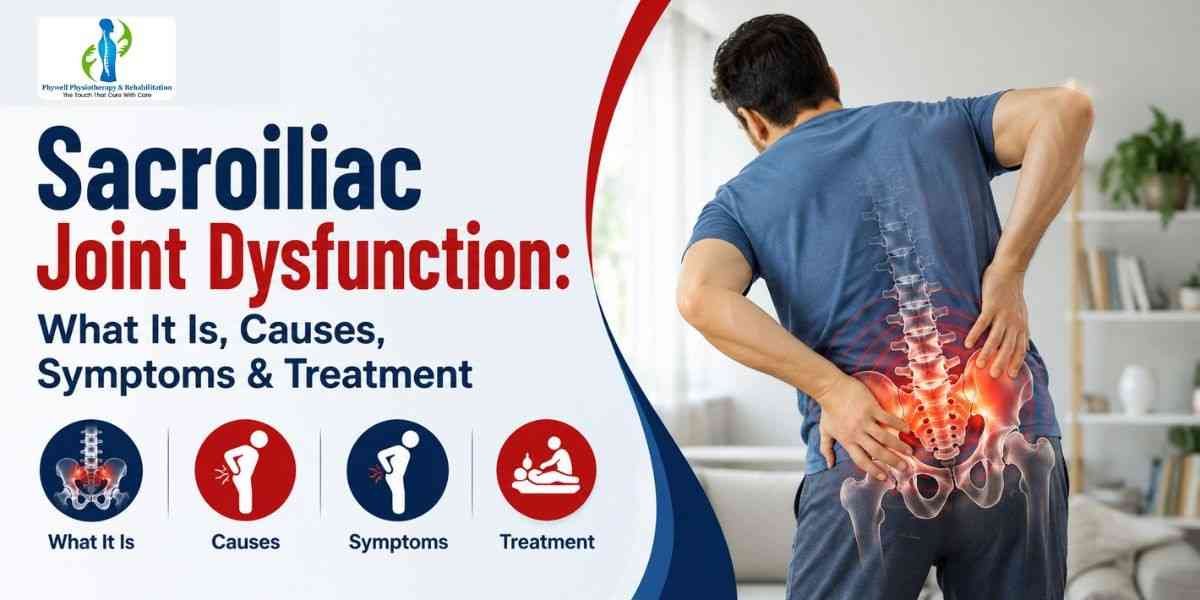
Sacroiliac Joint Dysfunction: What It Is, Causes, Symptoms & Treatment
Phywell Physiotherapy Team2026-08-13T08:29:16+00:00You can have a sore lower back without having a problem that actually starts in the spine. Sometimes the sacroiliac joint is involved. It sits where the lower spine meets the pelvis and helps transfer forces between your upper body and legs. When this area becomes sensitive or struggles to handle a particular load, everyday things such as walking, climbing stairs, getting out of a chair, or turning in bed can become uncomfortable.
If you are searching for the best physiotherapy centre in Delhi, the important thing is not simply finding someone who treats “back pain.” You want an assessment that looks at the spine, hips, pelvis, movement, and the activities that are giving you trouble. That is the approach followed at Phywell Physiotherapy in Shalimar Bagh, where treatment is planned around the individual rather than a standard exercise sheet.
Also Read: Sacroiliac Joint Pain: Causes, Symptoms, Diagnosis & Treatment
What Is Sacroiliac Joint Dysfunction?
The sacroiliac joint, or SI joint, connects the sacrum with the ilium of the pelvis. There are two of these joints, one on either side.
The SI joint does not move like your hip or shoulder. Its movement is small, but its job is important. It helps provide joint stability and contributes to load transfer between the trunk and lower limbs when you stand, walk, bend, or change position. AAFP describes the joint as helping transfer vertical loads from the lumbar spine to the lower extremities.
So what does Sacroiliac Joint Dysfunction actually mean?
In simple terms, it refers to symptoms or movement problems thought to involve the SI joint or structures around it. The word “dysfunction” does not mean that the pelvis has literally slipped out of place. That idea is common, but the real picture is usually less dramatic.
A clinician may consider joint mobility, pelvic stability, muscle strength, movement control, injury history, and how the person responds to different loads.
That wider view matters because the same area can hurt for several different reasons.
What Causes Sacroiliac Joint Dysfunction?
There isn’t one cause that fits everyone. Some people can point to an injury. Others notice symptoms after their activity level changes, and sometimes there is no obvious starting event.
Injury and Repeated Loading
A fall onto the buttocks, heavy lifting, or a motor vehicle accident can place considerable stress through the pelvis.
Repetitive loading can also play a role. Running, jumping, twisting, or sports that repeatedly load one side of the body may irritate the area, particularly when the workload changes quickly.
That doesn’t mean running is “bad” for the SI joint. The more useful question is whether the current workload matches the person’s capacity.
Pregnancy and Postpartum Changes
Pregnancy changes body weight distribution, walking patterns, and the demands placed on the pelvis. The SI joints and surrounding ligaments also experience different loads during pregnancy and after childbirth.
This is one reason SI joint problems are seen in pregnant and postpartum patients.
Still, pregnancy does not automatically mean someone has sacroiliac joint instability. A proper assessment should determine what is actually contributing to the symptoms.
Strength and Movement Control
Your pelvis doesn’t work by itself.
The gluteal muscles, hips, trunk, and other surrounding structures all contribute to how you move and absorb force. A physiotherapist may therefore look at muscle strength, single-leg control, gait, flexibility, and functional movement rather than examining the SI joint in isolation.
This does not mean that “weak glutes” are automatically the cause. Human movement is rarely that simple.
What Does SI Joint Dysfunction Feel Like?
The symptoms can be frustratingly vague.
Some people notice discomfort around one side of the buttock or the back of the pelvis. Others may feel it around the hip, groin, or upper part of the leg. Certain movements or positions may bring it on more reliably than others.
Activities that can aggravate symptoms include:
- Standing for a long time
- Climbing stairs
- Jogging or running
- Shifting more weight onto one leg
- Turning in bed
- Getting up from a chair
- Prolonged sitting
- Certain lifting or twisting movements
These patterns are useful clues, but they do not prove that the SI joint is the source.
For example, pain around the buttock can also occur with problems involving the lumbar spine or hip. That is why clinical assessment is more useful than trying to diagnose yourself from a pain-location chart.
How Is Sacroiliac Joint Dysfunction Diagnosed?
There isn’t a single scan or physical test that can settle every case.
A proper physical examination usually starts with your history. A clinician may ask when the symptoms began, whether there was an injury, what activities make them worse, and whether you have experienced numbness, weakness, or other symptoms.
The examination may then include the lumbar spine, hips, pelvis, gait, muscle strength, flexibility, and functional movement.
SI Joint Provocation Tests
A clinician may use several SI joint provocation tests during the examination. These tests apply controlled forces around the pelvis to see whether they reproduce the person’s familiar symptoms.
Common examples include the:
- Thigh thrust test
- Distraction test
- Compression test
- Gaenslen test
- Sacral thrust test
The important point is that these tests should not be treated like five separate yes-or-no answers.
AAFP recommends using a combination of provocation tests when SI joint dysfunction is suspected.
At the same time, research has highlighted limitations in using these tests as a standalone diagnosis. A 2021 systematic review found that clusters of positive provocation tests were better at helping clinicians rule out the condition when the cluster was negative than definitively proving the SI joint was the pain source when positive.
In other words, the examination is about putting several pieces together.
Do You Need an MRI or X-Ray?
Usually, imaging isn’t the first answer to suspected mechanical SI joint dysfunction.
An MRI, X-ray, or CT scan may be appropriate when a clinician needs to investigate another condition, structural problem, fracture, infection, or inflammatory disease. Imaging by itself does not reliably establish the SI joint as the source of symptoms.
In selected cases, a diagnostic injection containing local anesthetic can help determine whether the SI joint is contributing to symptoms, particularly when more invasive treatment is being considered.
How Is Sacroiliac Joint Dysfunction Treated?
Treatment depends on what the assessment finds.
For many people, the first step is conservative care rather than jumping straight to injections or surgery. AAFP lists physical therapy exercise programmes, SI joint manipulation, or a combination of these approaches among first-line options.
Physiotherapy and Exercise Therapy
Physiotherapy for SI joint dysfunction often focuses on making movement more comfortable and improving the body’s ability to handle everyday loads.
Depending on the person, treatment may include:
- Stabilization exercises
- Hip and gluteal strengthening
- Core strengthening
- Movement-control exercises
- Mobility work
- Functional movement training
- Activity modification
- Progressive rehabilitation
There isn’t one exercise that works for every SI joint.
Someone who develops symptoms while walking may need a different programme from a runner who feels discomfort only during uphill training. Someone recovering after pregnancy may have different priorities again.
A systematic review of physiotherapy interventions found that exercise and manipulation can help people with SI joint dysfunction, although the authors also noted limitations in the quality of the available studies.
More recent research has continued to investigate exercise and other physiotherapy approaches, with evidence suggesting that exercise-based treatment can improve pain and disability in people with SI joint dysfunction.
Manual Therapy
Manual therapy may be useful for some patients, particularly when combined with an active rehabilitation programme.
The point is not to keep “realigning” the pelvis every time symptoms appear. Instead, hands-on treatment can be one part of a larger plan that includes exercise, education, movement control, and gradual return to activity.
At Phywell Physiotherapy, treatment is tailored to the person’s condition, physical findings, lifestyle, and goals. The aim is to help the person become more capable, not dependent on repeated passive treatment.
What Does Rehabilitation Involve?
This is where treatment becomes more individual.
Early rehabilitation may involve reducing or modifying activities that consistently aggravate symptoms while keeping comfortable movement going. From there, the focus can shift towards strength, coordination, and pelvic stability.
As capacity improves, exercises can become more demanding.
A person might progress from basic stabilization work to squats, step-ups, single-leg activities, lifting, running, or sport-specific movements, depending on what they need to get back to.
The timing matters. Doing too little for too long can leave you underprepared for normal activity. Doing too much too soon can bring symptoms straight back.
Can Sacroiliac Joint Dysfunction Be Prevented?
No exercise can guarantee that SI joint problems will never happen.
What you can do is build the physical capacity you need.
That may mean maintaining hip and trunk strength, increasing training gradually, avoiding sudden jumps in workload, and giving your body time to adapt after an injury or a long break from exercise.
Good movement isn’t about keeping your pelvis perfectly still. It is about having enough control, strength, and tolerance for the movements your life demands.
When Should You Get SI Joint Symptoms Checked?
If symptoms keep returning or begin interfering with work, walking, exercise, sleep, or normal daily activities, an assessment is sensible.
You should seek medical attention promptly if back or pelvic symptoms occur with significant trauma, fever, unexplained weight loss, bowel or bladder changes, significant weakness, or other concerning neurological symptoms. These features can point towards conditions that need medical investigation rather than routine rehabilitation.
This is also where choosing the right professional matters. Back pain physiotherapy in Delhi should not begin with someone simply handing you an exercise sheet. The clinician should first work out whether the symptoms actually fit a musculoskeletal problem and whether another condition needs to be investigated.
Sacroiliac Joint Dysfunction: Treatment Should Fit the Person
The SI joint is a very small structure, but its contribution to pelvic movements is major. While moving, your pelvis, sacral bone, thigh bone, hips, lower spine, muscles, and other structures work in unison.
So, treating SI joint dysfunction shouldn’t only be concerned with finding the “right” stretch or trying to push the pelvis back to its “normal” alignment. Rather, you should first identify what factor/changes is bringing about the symptoms through movement analysis, the way you are using your body, and then gradually increase the strength and capacity of the pelvis to handle the various forces.
Physiotherapy at Phywell Physiotherapy in Shalimar Bagh takes care of different needs and is individualized per your condition, lifestyle, and goals of the rehabilitation. The aim is to assist you to move more freely, increase your function level, and get back to your favourite activities.
If your symptoms continue, or get back, or prevent the performance of your daily activities, please get in touch with Phywell Physiotherapy and raise your concerns for an assessment. An accurate diagnosis is crucial, as effective treatment relies on finding out what is actually leading to the problem.









Leave a Reply