
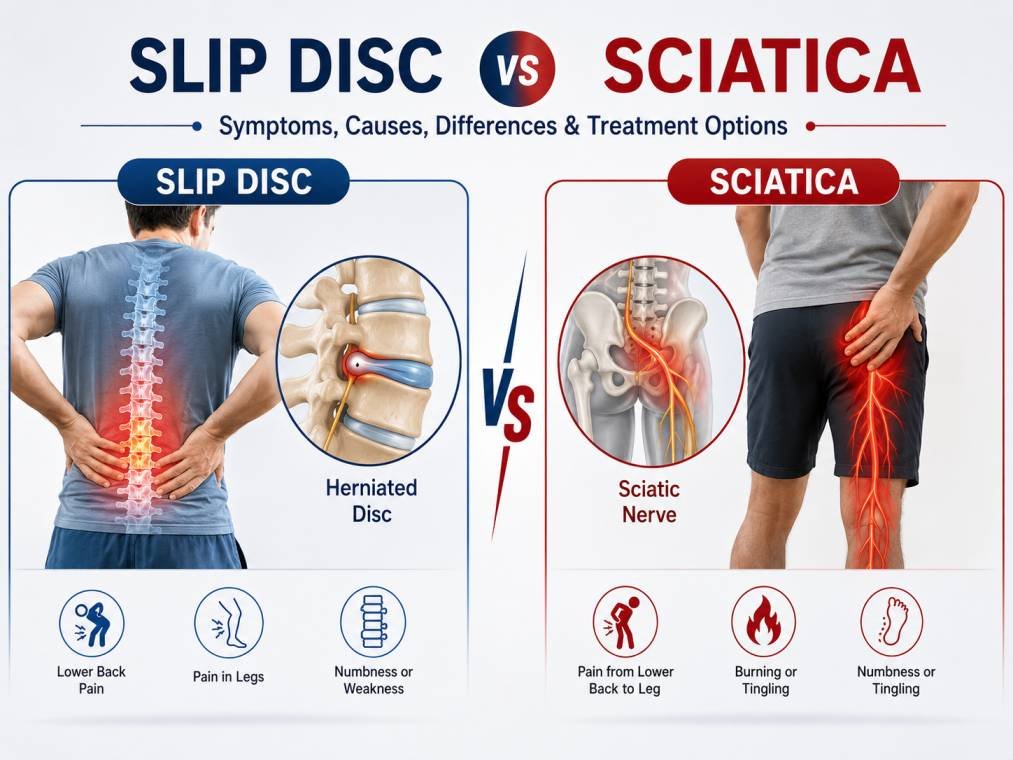
Slip Disc vs Sciatica: Symptoms, Causes, Differences & Treatment Options
Phywell Physiotherapy Team2026-09-05T10:58:05+00:00If you are searching for sciatica pain treatment in Delhi, you may have come across two terms that often create confusion: slip disc vs sciatica. They are related, but they are not the same thing. A slip disc, more accurately called a herniated disc, describes a problem with an Intervertebral Disc. Sciatica describes pain and other symptoms caused by irritation or compression affecting the Sciatic Nerve or its nerve roots. In simple terms, one can be a cause, while the other describes a pattern of symptoms.
What Is a Slip Disc?
A “slip disc” is a common term for a herniated disc. Despite the name, the disc does not literally slip out of the spine. An Intervertebral Disc sits between the Vertebrae and acts as a cushion. When part of the disc bulges or its inner material pushes through a weakened outer layer, it can irritate nearby nerves.
A bulging disc and a herniated disc are related but not identical terms. An MRI may show different forms of disc displacement, including a bulge, protrusion or herniation. However, an imaging finding does not automatically mean that the disc is responsible for someone’s pain. Some people have disc changes without noticeable symptoms.
A spinal disc problem may cause lower back pain, stiffness in the lower back, or symptoms in a leg when it affects a nearby Nerve Root.
What Is Sciatica?
Sciatica is a symptom pattern involving the Sciatic Nerve, which is formed from nerve roots in the lower part of the spine and travels through the buttock and into the leg.
Typical sciatica symptoms include sharp, burning or shooting sciatic nerve pain that travels from the lower back or buttock into the leg. Some people also experience a tingling sensation, numbness in the leg or foot, or weakness in the affected leg.
Sciatica can happen because of a herniated disc, but a disc is not the only possible cause. Spinal stenosis, other changes around the spine, and irritation or inflammation around a nerve root can also produce similar symptoms.
Also Read: Sacroiliac Joint Dysfunction: What It Is, Causes, Symptoms & Treatment
Slip Disc vs Sciatica: What Is the Difference?
The easiest way to understand slip disc vs sciatica is to separate the cause from the symptoms.
| Slip Disc | Sciatica |
| A structural problem involving a spinal disc | A pattern of nerve-related symptoms |
| Usually involves disc bulging or herniation | Usually involves irritation or compression of a nerve root |
| May cause back pain | Often causes pain travelling into the buttock or leg |
| Can occur without symptoms | Usually refers to noticeable nerve-related symptoms |
| Can be one cause of sciatica | Can have several possible causes |
So, having a slip disc does not automatically mean you have sciatica. Likewise, having sciatica does not prove that you have a herniated disc.
Think of it like a faulty cable and the warning light on your dashboard. They are connected, but they are not the same thing.
Common Symptoms to Watch For
The symptoms depend on which structures are affected and how strongly the nerve is irritated.
Common symptoms may include:
- Lower back pain
- Leg pain, particularly pain travelling below the buttock
- Tingling sensation or pins and needles
- Numbness in the leg or foot
- Weakness in the affected leg
- Stiffness in the lower back
- Pain while sitting
- Pain while bending
- Reduced mobility
- Difficulty walking in more severe cases
Nerve root irritation can result from pressure on the spinal nerve, but inflammation around the nerve can also contribute to symptoms. This is one reason why pain severity does not always match what an MRI shows.
What Causes a Slip Disc and Sciatica?
Herniation of a disc may result from weakness and changes in the disc. Aging, some forms of lifting, inactivity and other factors that put pressure on the spine may lead to it. Sometimes, however, there may be no clear reason for a disc herniation.
The sciatica condition arises if a nerve root gets irritated or compressed. One of the causes of sciatica is a herniation of the lumbar disc; other problems, such as spinal stenosis, can irritate the nerve too.
This is important because treatment must consider the patient’s symptoms and signs, not just the MRI results.
How Are Slip Disc Vs Sciatica Diagnosed?
A healthcare professional usually begins with your symptoms and a physical examination. They may assess your movement, strength, sensation and reflexes.
An MRI can provide detailed images of soft tissues and may help evaluate a suspected herniated disc when imaging is clinically appropriate. However, MRI is not automatically required for every case of back pain or sciatica.
An Orthopedic Specialist, Physiotherapist or other qualified healthcare professional can help determine whether symptoms suggest nerve involvement and whether further investigation is appropriate.
Slip Disc Treatment and Sciatica Treatment Options
Most people with uncomplicated sciatica or a herniated disc improve without surgery. Treatment depends on the symptoms, examination findings and how the condition progresses.
1. Stay Active
Long periods of complete bed rest are generally not recommended. Gentle movement and a gradual return to normal activities can support recovery. Your activity level should match your symptoms and professional advice.
2. Physiotherapy
Physiotherapy can form an important part of back pain treatment and slip disc treatment. A qualified Physiotherapist can assess movement, strength and functional limitations before developing an appropriate exercise and rehabilitation plan.
For people looking for the best physiotherapy in Delhi, the important point is not simply choosing a clinic with a strong marketing claim. Look for qualified professionals, appropriate assessment and treatment that matches your individual condition.
3. Medicines and Other Treatments
Depending on your situation, a doctor or pharmacist may recommend appropriate pain-relief medicines. Some patients may also receive other treatments, such as injections, when clinically appropriate.
Spinal Decompression, manual therapy or treatment from a Chiropractor may be considered in selected situations, but these should not replace a proper clinical assessment. The right treatment depends on the underlying problem and the person’s symptoms.
4. Surgery
Surgery is not necessary for most people. However, a specialist may consider decompression or a procedure such as microdiscectomy when significant symptoms persist despite appropriate non-surgical care or when neurological problems require specialist management.
Physical Rehabilitation after an injury or procedure can also help restore movement, strength and daily function.
When Should You Seek Urgent Medical Help?
Most cases of sciatica are not emergencies, but certain symptoms require urgent assessment. Seek emergency medical attention if you develop numbness around the genitals or buttocks, problems passing or controlling urine or stool, or significant symptoms affecting both legs.
Do not try to diagnose serious nerve problems through an online search. Your spine deserves more respect than a late-night search result.
Finding Appropriate Care in Delhi
When choosing between various places to treat sciatica in Delhi, ensure that you have done a proper assessment of all aspects and choose professional services according to your symptoms, and not any claims about quick results.
In case you have been searching for locations through a particular landmark or business, such as Phywell Physiotherapy, refer to the Google Maps and Google business listing to determine the exact location and address. Phywell Physiotherapy cannot be considered as a healthcare center unless stated so in their business listing.
Similarly, if your search for best physiotherapy in Delhi leads you to several providers, compare qualifications, assessment methods, patient education and rehabilitation planning rather than relying only on star ratings.
Final Takeaway
The important distinction between slip disc vs sciatica lies in their definitions. The slip disc is basically related to disc problems, whereas sciatica is more of a nerve symptom that affects the buttocks and the leg. The herniated disc causes sciatica, but there are other causes as well.
Diagnosis is important as treatment is dependent on the root cause. Many patients benefit from exercise and even Physiotherapy and Physical Rehabilitation, while some others need further diagnosis and perhaps surgery.
If you are considering sciatica treatment or back pain treatment, choose evidence-based care and seek professional assessment when symptoms persist, worsen, or include neurological changes. Contact Us if you need guidance about your treatment options. And if you are using Phywell Physiotherapy as a local search reference, verify the business location independently rather than implying that it provides medical care.
Frequently Asked Questions
No. A slip disc, commonly called a herniated disc, is a problem involving an intervertebral disc. Sciatica refers to pain and other symptoms caused by irritation or compression of the sciatic nerve or its nerve roots. A herniated disc can cause sciatica, but they are not the same condition.
Yes. A herniated disc in the lumbar spine can irritate or compress a nearby nerve root and cause symptoms that travel into the buttock and leg. However, sciatica can also have other causes.
Common symptoms include shooting or burning pain travelling from the lower back or buttock into the leg, tingling, numbness and weakness. Some people may also experience difficulty walking or increased pain while sitting.
Yes. A disc problem does not always cause nerve-related symptoms. Some people may have a herniated or bulging disc without experiencing sciatica.
A healthcare professional usually starts with your medical history and physical examination. An MRI may be recommended in selected cases when imaging can help guide diagnosis or treatment.
Treatment depends on the cause and severity of symptoms. Depending on the individual case, it may include staying active, appropriate medication, physiotherapy and physical rehabilitation. Some people with persistent or severe symptoms may require specialist treatment.
No. Most people with uncomplicated sciatica do not require surgery. A specialist may consider surgery when significant symptoms persist despite appropriate non-surgical treatment or when serious neurological problems develop.
You should seek professional assessment if pain persists, worsens, significantly affects daily activities, or is accompanied by numbness or weakness. Urgent medical attention is needed for symptoms such as loss of bladder or bowel control or numbness around the genital or buttock area.
Physiotherapy can be an important part of managing many cases of sciatica and lower back problems. A qualified physiotherapist can assess your symptoms and create an appropriate exercise and rehabilitation plan based on your condition.
Yes. Many cases of sciatica improve over time with appropriate self-care and conservative treatment. However, persistent, worsening or severe symptoms should be assessed by a qualified healthcare professional.




Leave a Reply