
Slip Disc (Slipped Disc) vs Herniated Disc: What’s the Difference?
Back pain has become extremely common, especially among people who spend long hours sitting, working on laptops, or following a less active lifestyle. Many people use the terms slipped disc and herniated disc as if they mean two different problems. However, both terms are closely related and often describe the same underlying condition.
If you are searching for the Best physiotherapy centre in Delhi for back pain management, understanding the actual difference between these terms can help you make better decisions about diagnosis and treatment.
The truth is simple: slipped disc is a common term used by patients, while herniated disc is the medically accepted term used by healthcare professionals. A proper diagnosis helps identify the severity of the condition and the right recovery approach.
Understanding the Spine and Intervertebral Disc
Before understanding the difference between a slipped disc and a herniated disc, it is important to know how your spine works.
The human Spine or Vertebral Column consists of multiple bones called vertebrae. Between these vertebrae are soft structures known as Intervertebral Disc, which act like cushions and help absorb pressure during movement.
These discs allow flexibility in different areas:
- Cervical Spine – the neck region
- Thoracic Spine – the upper and middle back region
- Lumbar Spine – the lower back region
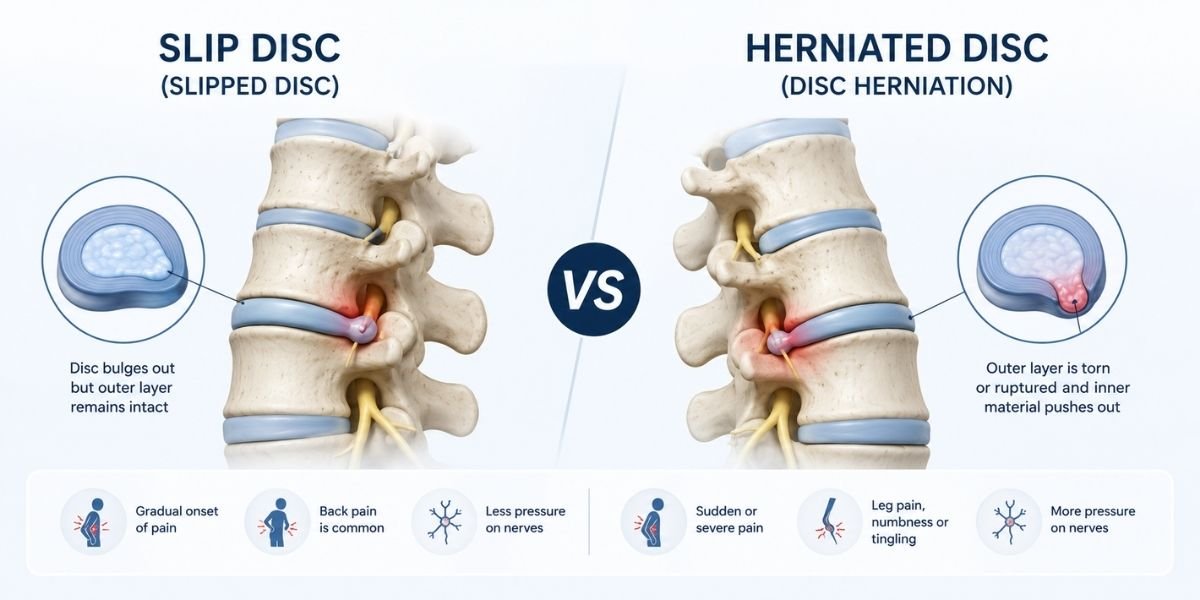
Each disc has a soft inner portion and a stronger outer layer. When the outer layer becomes damaged, the inner material may move outward, which can irritate nearby Spinal Nerves and cause pain.
What Is a Slipped Disc (Slipped Disc)?
A slipped disc is a commonly used phrase to describe a problem where an intervertebral disc becomes damaged or moves from its normal position. Although people often imagine that the disc has literally slipped out, the disc does not completely fall out of place.
The condition usually happens when the outer layer of the disc develops a tear or weakness. This allows the inner gel-like material to push outward.
Common Slipped Disc Causes
Several factors can contribute to disc problems, including:
- Age-related disc wear and tear
- Poor sitting posture
- Repeated heavy lifting
- Sudden twisting movements
- Lack of physical activity
- Weak supporting muscles
People who sit for long hours at work may experience gradual disc stress, which can eventually lead to discomfort.
Common Slipped Disc Symptoms
Symptoms can vary depending on the location and severity of the disc problem. Common signs include:
- Lower back pain
- Neck pain
- Pain spreading to arms or legs
- Tingling sensation
- Numbness
- Muscle weakness
- Difficulty walking
Some people experience sharp shooting pain, while others may feel dull aching pain or chronic discomfort.
What Is a Herniated Disc?
A herniated disc is what doctors call it when the stuff inside a spinal disc breaks through the tough outer part.
This is what healthcare professionals say because it explains what really happens to the disc.
A herniated disc can happen in any part of the spine. It usually happens in the Lumbar Spine.
The reason for this is that the Lumbar Spine has to support a lot of body weight. A herniated disc is more likely to occur there.
Herniated Disc Causes
The common causes of disc herniation include:
- Natural ageing process
- Disc degeneration
- Repeated stress on the spine
- Improper lifting techniques
- Previous spinal injuries
In some cases, the displaced disc material can irritate a Nerve Root, causing symptoms such as sciatica pain or weakness in specific areas.
Herniated Disc Symptoms
Symptoms depend on whether the disc affects nearby nerves. They may include:
- Severe back pain
- Pain radiating into the legs or arms
- Nerve compression symptoms
- Limited mobility
- Painful movement
- Muscle weakness
Not every herniated disc causes symptoms. Some people may have disc changes visible on imaging without experiencing noticeable pain.
Slip Disc vs Herniated Disc: Key Differences
| Difference | Slip Disc | Herniated Disc |
| Meaning | Common term used by people | Medical term used by doctors |
| Medical accuracy | General description | Specific diagnosis |
| Condition | Disc movement or damage | Inner disc material pushes through outer layer |
| Symptoms | Back pain, stiffness, discomfort | Pain, nerve irritation, numbness, weakness |
| Diagnosis | Usually needs medical evaluation | Confirmed through clinical assessment and imaging |
So, when someone says they have a slip disc, they are usually referring to what doctors call a herniated disc.
Symptoms That Should Not Be Ignored
Many people ignore back pain until it starts affecting daily activities. Occasional discomfort may improve with rest, but certain warning signs need professional attention.
You should consider medical guidance if you experience:
- Persistent lower back pain
- Pain travelling down your leg
- Severe or increasing discomfort
- Difficulty walking
- Loss of strength
- Numbness or tingling
A sudden increase in symptoms or unbearable pain should not be managed only with home remedies.
Early evaluation can help prevent the condition from affecting your quality of life.
How Are Slip Disc and herniated discs diagnosed?
Doctors usually begin with a physical examination and review of symptoms. They check movement, muscle strength, reflexes, and nerve function.
If required, doctors may recommend imaging tests such as Magnetic Resonance Imaging (MRI) to understand the condition of the disc and surrounding structures.
An MRI can help identify:
- Disc damage
- Nerve compression
- Disc protrusion
- Location of the affected disc
Orthopedics and spine specialists use these findings to decide the most suitable treatment approach.
Treatment Options for Slipped Disc and Herniated Disc
Treatment depends on the severity of symptoms. Many people improve with non-surgical approaches.
Common treatment options include:
Physiotherapy
Physiotherapy focuses on improving strength, flexibility, posture, and movement control. A structured rehabilitation program can help reduce pain and improve daily function.
A professional team like Phywell Physiotherapy focuses on assessment-based treatment plans where exercises and therapies are selected according to individual patient needs.
Exercise and Rehabilitation
You should do exercises to make your spine stronger and your muscles more stable. These exercises can really help your health. You have to do them the right way. If you do not do them correctly, it can hurt you more. So it is an idea to have someone show you how to do the exercises properly. This way, you can get the most out of the exercises. Improve your muscle stability and spinal health.
Spinal Decompression Machine Treatment
Some physiotherapy centres use advanced approaches such as Spinal decompression machine treatment as part of a comprehensive rehabilitation program. The suitability of this treatment depends on individual assessment and the advice of a qualified professional.
Surgery
Surgery is not required for every disc problem. Doctors may consider surgical options when symptoms are severe, persistent, or when significant nerve problems develop.
When Should You Visit a Physiotherapist?
A physiotherapist can help you understand movement limitations and create a recovery plan if you experience:
- Repeated back pain episodes
- Difficulty performing daily activities
- Reduced flexibility
- Posture-related discomfort
- Recovery needs after medical treatment
Choosing an experienced clinic matters because spine-related problems require proper evaluation. Phywell Physiotherapy provides professional physiotherapy services focused on patient assessment, rehabilitation, and improving functional movement.
For people looking for a physiotherapy centre, selecting a centre with qualified professionals and personalized treatment planning can make a significant difference in recovery.
Conclusion: Managing Slipped Disc and Herniated Disc Effectively
The terms slipped disc and herniated disc can be confusing. They are usually talking about the same kind of problem with the discs in your spine. If you know what symptoms to look for, what causes them. How to treat them, you can do the right thing at the right time.
Do not ignore back pain that will not go away, symptoms that affect your nerves or problems with moving. You should see a doctor or a healthcare professional to get an idea of what is wrong with you. They can help you make a plan to get better and take care of your spine in the long run.
Are you having back pain, symptoms of sciatica or problems moving around? You should get in touch with Phywell Physiotherapy. They can give you an assessment and expert advice from a physiotherapist to help you with your spine health and to recover from your problems.
Frequently Asked Questions
Is slip disc the same as a herniated disc?
Yes, in most cases these terms refer to the same condition. “Slip disc” is a common term, while “herniated disc” is the medically accurate term.
Can physiotherapy help with a herniated disc?
Physiotherapy can help many people manage symptoms by improving strength, mobility, posture, and movement patterns. Treatment depends on the individual’s condition.
Is a herniated disc always painful?
No. Some people may have disc changes without experiencing symptoms. Pain usually occurs when the affected area irritates nearby nerves or tissues.
How long does recovery from a slipped disc take?
Recovery time varies depending on the severity, symptoms, lifestyle factors, and treatment approach. A healthcare professional can provide guidance based on individual assessment.






Leave a Reply