
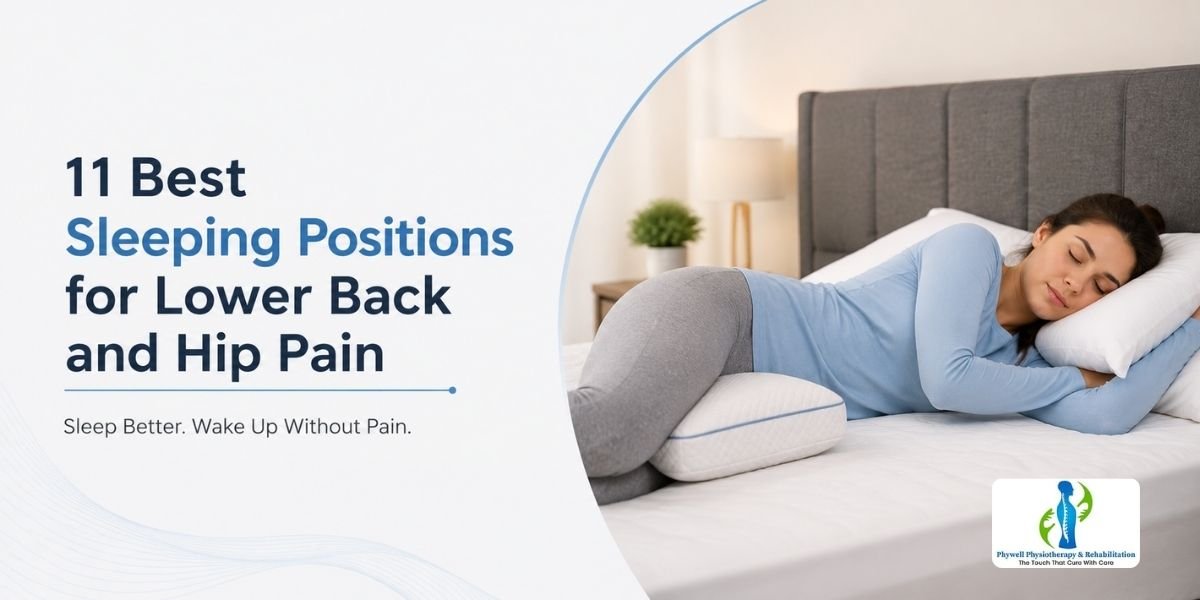
11 Best Sleeping Positions for Lower Back and Hip Pain
Phywell Physiotherapy Team2026-07-13T10:04:30+00:00
You finally crawl into bed after a long day, hoping for some well-deserved restorative sleep. But instead of drifting off to dreamland, you end up wrestling your mattress like an Olympic gymnast. Waking up feeling like you spent the night folding yourself into a human pretzel is not just annoying; it ruins your entire day. If you suffer from aches in your lumbar spine or hips, finding the right sleeping position for lower back pain is crucial.
At Phywell Physiotherapy, we see patients constantly who sabotage their physical recovery simply by sleeping incorrectly. In fact, if you are currently seeking back pain physiotherapy in Delhi, one of the first things your specialist will ask about is your sleep ergonomics. You cannot out-exercise a bad mattress or 8 hours of terrible spinal alignment.
The goal of a great night’s sleep is to achieve a relaxation response where your musculoskeletal system finally gets a break. Let’s look at the science-backed, logic-driven ways to align your body mechanics for optimal pain relief. Here are the 11 best sleeping positions for lower back and hip pain.
Also Read: Laptop vs Mobile: Which Causes More Neck Pain?
The Science of Sleep and Spine Alignment
Before we jump into the positions, you need to understand one basic rule: the neutral spine. A healthy spine sleeping habit means keeping your ears, shoulders, and hips in a relatively straight line. When you twist or bend awkwardly, you create pressure points. This forces your muscles to stay tense all night to protect your spinal discs. By utilizing proper body positioning for pain reduction, you take the workload off your back. Let’s break down the 11 configurations that promote tension relief and comfort optimization.1. Side Sleeping with a Pillow Between the Knees
If you love sleeping on your side, you probably notice that your top leg tends to drop forward. This twists your pelvis and strains your lower back. The Fix: Place a firm pillow between your knees. This simple pillow placement for spine alignment prevents your top leg from pulling your spine out of alignment. Side sleeping for spinal support works wonders when you keep your hips stacked perfectly on top of each other.2. The Fetal Position
If you suffer from a herniated disc, bending forward can open up the space between your vertebrae and reduce nerve compression. The Fix: Tuck your knees securely toward your chest and curl your torso. This is an excellent sleeping posture for sciatica relief because it creates spinal comfort by opening the joint spaces in your lumbar spine.3. Back Sleeping with a Pillow Under the Knees
Lying flat on your back forces your lower back to arch, which can trigger sleep discomfort. The Fix: Slide a pillow right under your knees. This flattens your lower back against the mattress and maintains the natural curve of your spine. For many patients, this ranks as the absolute best sleeping position for back pain.4. The Reclined Back Sleeping Position
Do you find yourself falling asleep easily in a recliner chair? You aren’t alone. The Fix: Use an adjustable bed or a specialized wedge pillow to elevate your upper body slightly. This angle reduces pressure on the lower back and is one of the top sleeping tips for chronic back discomfort, especially for a condition called isthmic spondylolisthesis.5. Stomach Sleeping with a Pelvic Pillow
Most experts tell you to avoid sleeping on your stomach because it flattens the natural curve of your spine and strains your neck. But if you simply cannot fall asleep any other way, you can modify it. The Fix: Place a thin pillow beneath your pelvis and lower abdomen. This provides essential nighttime lower spine support and relieves pressure on the spinal discs.6. Side Sleeping with a Waist Gap Support
Sometimes, even with a pillow between your knees, there is a massive gap between your waist and the mattress. Gravity pulls your spine down into that gap. The Fix: Place a small, rolled-up towel under your waist. This fills the gap and guarantees your spine stays straight. It is a brilliant example of active posture correction during sleep.7. Back Sleeping with a Lumbar Roll
If a pillow under the knees isn’t quite enough, you can add targeted support to your lower back. The Fix: Roll up a thin towel and place it directly under the small of your back. This bridges the gap between your body and the mattress, offering excellent lumbar support while sleeping.8. The Full Body Pillow Hug
A standard head pillow often isn’t enough to secure your body. The Fix: Use a long posture support pillow. Wrap your arms and legs around it. A full-body pillow prevents you from rolling onto your stomach halfway through the night. Utilizing back support cushions for sleep is an easy way to achieve hip and spine alignment without constantly waking up to adjust.9. Elevated Legs Position
If you have lower back pain that shoots down your legs, elevating your feet can change the game entirely. The Fix: Sleep on your back and put your lower legs up on a stack of firm pillows or a dedicated leg wedge. This technique bends your knees at a 90-degree angle, entirely flattening your lower back against the bed for extreme pressure reduction.10. Flat Stomach Sleeping with No Head Pillow
If you must sleep on your stomach (with a pillow under your pelvis), your head pillow might be the enemy. The Fix: Ditch the head pillow entirely. A thick pillow forces your cervical spine into a harsh backward bend. Removing it keeps your neck and back alignment much closer to neutral. If you struggle with upper back issues, seeking cervical pain treatment in Delhi alongside this sleep position for back pain can drastically improve your mobility.11. The Supported Starfish
Sleeping on your back with your arms up near your head (the starfish) distributes your body weight evenly, but it can still arch the back. The Fix: Place small pillows under both of your knees and perhaps tiny rolled towels under your elbows. This creates an even distribution of weight across all pressure points. Many patients at Phywell Physiotherapy find this to be the best sleeping position for lower back pain when dealing with widespread muscle stiffness.Upgrade Your Sleep Environment
You can master every sleeping position for back pain, but if your bed resembles a sinking ship, you will still wake up in agony. Your mattress and pillows are your tools for physical recovery.- Mattress Support for Back Pain: You need a mattress that pushes back. A medium-firm orthopedic mattress usually offers the best balance of comfort and support. If your mattress sags in the middle, it acts like a hammock, which is a disaster for your vertebrae.
- The Right Pillow: Your pillow’s only job is to fill the gap between your neck and the mattress. A memory foam pillow contours to your shape and prevents your head from tilting too far in any direction.









Leave a Reply